Free and happy hens banner copyright: Copyrights © WDnet Digital Creation Studio - All Rights Reserved.

Avian influenza/bird flu

As of 09.03.2026

Share this page:
Automatic Translation

This page was translated from German using artificial intelligence. The translation may contain errors or inaccuracies. In case of doubt, the German original version prevails.

Detection of avian influenza in a wild goose

As part of wild bird monitoring, a wild goose was tested for the avian influenza virus. The Friedrich Loeffler Institute has now officially confirmed that the highly pathogenic avian influenza virus (H5N1) was detected. (As of 09.03.2026)

The wild goose was found at the Bever reservoir. As this is a wild bird, no further control measures will be taken.

The Veterinary and Food Monitoring Office of the Oberbergischer Kreis advises poultry keepers to exercise caution.

Among wild birds, particularly cranes, there has been an increase in detections of the highly contagious avian influenza virus. Domestic poultry flocks across Germany are now also affected. According to the Friedrich Loeffler Institute (FLI), the risk of infection for humans is low.

The avian influenza virus is now permanently present in the wild bird population in Europe. The introduction of the virus by migratory birds poses a risk. Entry into domestic poultry flocks can occur through direct or indirect contact with infected wild birds.

Avian influenza is notifiable and highly contagious. In domestic poultry, it can lead to severe disease and even death. In autumn and winter, low temperatures favour the survival of avian influenza viruses and can lead to rapidly spreading disease outbreaks during the cold season.

The Veterinary Office strongly recommends that poultry keepers observe biosecurity measures to protect their birds from a possible introduction of the pathogen.

Guidance for poultry holdings:

The following protective measures are recommended for all poultry holdings, regardless of flock size:

  • Poultry should only be fed in places inaccessible to wild birds. No surface water should be used to water the animals.

  • Poultry housing and runs should only be entered wearing separate stable clothing and footwear; droppings sticking to the soles of shoes can contribute to further spread.

  • Thorough cleaning and disinfection before every restocking or after every destocking of poultry, as well as of transport vehicles and containers for poultry.

  • Minimising direct and indirect contact opportunities between poultry and wild waterfowl, as well as contact with natural water bodies.

  • Feed, bedding and other items that poultry may come into contact with should be stored inaccessible to wild birds.

  • In the event of increased animal losses in the flock, a veterinary examination by the farm veterinarian is required.

  • Every poultry holding, including hobby and very small holdings, must be reported to the responsible Veterinary Office and the North Rhine-Westphalia Animal Disease Fund.

  • If dead or behaviourally conspicuous wild birds are found in a location, the Veterinary Office of the Oberbergischer Kreis should be notified. Dead animals should not be touched.
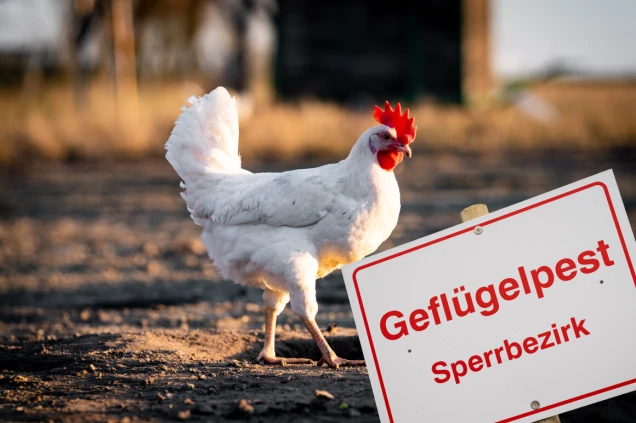
Symbolfoto -  Ausbruch einer Seuche wie etwa der Vogelgrippe in einem dichten Veredelungsgebiet mit vielen Geflügelhaltern.

Reports of animal finds are received by the Veterinary Office on tel. no. 02261 88-3903 or via amt39@obk.de.

Questions and answers

Avian influenza (also commonly known as bird flu) is a particularly severe disease in poultry and other birds, caused by highly pathogenic influenza viruses of the H5 and H7 types. There are also other types that do not have such a strong disease-causing effect, known as low pathogenic influenza viruses. Wild waterfowl can carry the pathogen without often becoming ill themselves. They therefore form a natural virus reservoir for the pathogen. Domestic poultry, such as chickens, turkeys, guinea fowl, domestic ducks and geese, peacocks, ostriches, emus and rheas, are susceptible. Many wild birds, especially waterbirds such as wild ducks, wild geese, swans, gulls, and birds of prey, as well as pheasants, partridges and quails, are susceptible to avian influenza. Wild poultry (particularly wild ducks) can be regarded as a reservoir of the virus. These animals are carriers of the virus without becoming ill themselves.

The virus can occur in a mild or highly pathogenic type. Typical symptoms are difficulty breathing, exhaustion, fluid accumulation in the head region, diarrhoea, a drop in egg production and blue discolouration of the skin.

Avian influenza is highly contagious. The incubation period (the time between infection and the onset of symptoms) ranges from a few hours up to 21 days. The disease can then progress rapidly and is usually fatal, with mortality potentially exceeding 90%. If at least 3 deaths occur within 24 hours in smaller poultry flocks of up to 100 birds, this is a clear indication of avian influenza.

A protection zone (formerly a restricted zone) with a radius of at least three kilometres is first established around the disease-affected holding. Further examinations are carried out in poultry holdings within this protection zone. In addition, a surveillance zone (formerly "observation area") with a radius of at least ten kilometres is established around the disease-affected holding. In these restricted zones, a housing requirement applies to all susceptible birds. Further measures such as improved hygiene, disinfection measures and access bans aim to protect poultry stocks from an introduction of avian influenza and to prevent the spread of the virus from the affected area through animal contact, indirect contact via people, transport containers, packaging material, egg cartons or bedding.

The exact location of the two zones mentioned, as well as all protective measures ordered within the restricted zones, will be published promptly in a general order issued by the animal disease authority, which can then also be viewed on the website of the Oberbergischer Kreis at www.obk.de/oeffbek.

If not already done, poultry keepers must immediately report the number, type of use and location of the animals kept to the Veterinary Office by e-mail (amt39@obk.de).

Captive birds must be kept in closed stalls or under a protective device consisting of a projecting, overhead-secured covering that is impervious to ("bird droppings") entries and a side boundary secured against the entry of wild birds.

Persons keeping animals in the protection or surveillance zone must monitor their animals more closely (increased mortality rate, reduced mobility of the animals, marked increase or decrease in production data). Any noticeable change must be reported to the Veterinary Office immediately by telephone or e-mail.

Poultry keeping is in principle blocked: birds, meat from poultry and feathered game, eggs and other products and animal by-products originating from poultry and feathered game from the protection or surveillance zone may not leave the respective holding, nor may they be newly brought into a holding from this zone.

To protect against biological hazards, persons keeping poultry must take enhanced hygiene measures; these are explained in more detail in the information sheet "Protective measures against avian influenza in small poultry holdings" of the Friedrich Loeffler Institute (FLI).

Yes, all measures taken or ordered also apply to persons who keep individual animals.

Yes, the measures apply to all birds kept. Homing pigeons are animals susceptible to the avian influenza virus.

Anyone can unknowingly spread avian influenza.

This applies to all persons who keep poultry or visit locations with poultry, regardless of whether it is a commercial or private (hobby) operation. Avian influenza can spread very easily via clothing, shoes, hands and objects. The virus can be present without being noticed. A little bit of droppings under one's shoes, for example, is enough to carry the virus further.

It should therefore be avoided to visit locations with poultry and to feed poultry, including wild fowl.

The Veterinary Office of the Oberbergischer Kreis appeals to poultry keepers, even outside the restricted zones, to protect their poultry stocks as best as possible from a potential introduction of the pathogen.

Those who can should keep their animals housed, or cover the enclosure from above and fit the sides with nets or fine-mesh wire, so that no virus can enter the enclosure via droppings or wild birds.

Feed and water may only be offered in places inaccessible to wild birds. In the event of increased animal losses, a veterinarian should be consulted to clarify any unclear disease occurrence in the flock.

Poultry holdings must be reported to the Veterinary Office and the animal disease fund. If this has not yet been done, the report should be submitted as soon as possible, including for hobby holdings, stating the number, type of use and location of the animals kept, by e-mail (amt39@obk.de).

Avian influenza is an animal disease that has so far been transmitted from animals to humans only extremely rarely and only under certain conditions. No transmissions to humans have become known with the currently circulating H5N1 influenza virus. Human-to-human spread has not been observed so far.

However, this could become possible if the virus changes its characteristics, especially in the case of a high viral load, as can be expected in poultry holdings affected by avian influenza. If avian influenza is suspected, a mouth-and-nose covering and protective goggles should be worn when entering the barns.

Under normal circumstances, people do not have close contact with wild birds. There is an extremely small possibility that the human body might have to fight off an infection with a human influenza virus and the avian influenza virus at the same time, and that a new, dangerous virus could form from the two viruses.

Yes. With normal kitchen preparation, i.e. heating above 75°C, there is no danger to the consumer. When handling raw and frozen poultry, the general hygiene guidelines should be followed, such as:

  • Unpack deep-frozen poultry to thaw it.

  • Pour away the thawing liquid.

  • Thawed poultry meat should not come into contact with other foods.

  • Thoroughly clean utensils and cutting boards before using them for other foods.

  • Thoroughly clean the work surface and your hands in between.

According to the Friedrich Loeffler Institute, cats can become infected and can also become ill. However, despite the many wild bird cases, no cases have become known in Germany since 2006. Cats should, as far as possible, be kept away from dead wild birds.

Dogs are barely susceptible; nevertheless, in affected areas (restricted zones) they should be kept on a leash to avoid contact with dead wild birds.

As a general rule, dead or sick birds should not be touched or taken away. Particular caution is advised with dead waterfowl such as ducks, geese, swans and gulls. However, not every dead bird has necessarily died of avian influenza. Natural death of animals is also part of the cycle of nature, and bird mortality tends to increase after long winters. If several sick or dead birds are found at the same time, please notify the veterinary office, the regulatory office or the police.

Dead wild birds can be handed in at the veterinary office during normal opening hours.

Hands should be washed thoroughly with soap and water, and soiled clothing should be cleaned in the washing machine. The risk of contracting bird flu is extremely low; if flu symptoms occur, medical advice should be sought immediately.

Yes, there is no increased risk of infection. However, shoreline areas heavily contaminated with bird droppings should be avoided. In case of skin contact with droppings: wash your hands!

Bird feathers can be contaminated with droppings and generally should not be touched with bare hands or put in the mouth. If children play with bird feathers anyway, thorough hand washing should follow.

These birds are in principle susceptible; however, if they are kept indoors only, there is no danger.

For large areas, dust formation, e.g. through sweeping or brushing, should definitely be avoided. The use of high-pressure cleaners should also be avoided, as dust and droppings would initially be further dispersed by the pressure. If the areas cannot be cleaned in any other way, work with a protective mask and rubber gloves. Work clothing should then be thoroughly cleaned (soap solution or washing machine). In the event of skin contact with bird droppings, thoroughly clean the skin with water and soap.

Songbirds are not among the main bird species susceptible to avian influenza. If feeding, direct contact with droppings should always be avoided. Afterwards, it is important to wash your hands with soap. The feeding site should be cleaned at regular intervals and always kept clean.

Because the transmission routes of avian influenza viruses among wild birds are unclear, ducks and swans in parks and green spaces should not be fed. Furthermore, the water in smaller ponds becomes contaminated quickly, and the animals lose the ability to find food for themselves.

A conventional flu vaccination against "real flu" does not protect against so-called bird flu. A flu vaccination merely prevents the combination of avian influenza viruses with human viruses if a person with influenza has contact with infected poultry.

There are medications for treating an infection with influenza viruses, so-called "neuraminidase inhibitors". They help against normal flu and also against infection with the avian influenza virus.

Questions about avian influenza are answered by telephone at 02261 88-3903 and by e-mail at überamt39@obk.de.

Downloads

Avian influenza checklist from the Friedrich-Löffler-Institut

Fact sheet: Protective measures against avian influenza in small-scale poultry keeping

FAQ from the Frierich-Löffler-Institut

Your way to us:

Veterinary and Food Inspection Office

Stahlstr. 5
51645 Gummersbach-Dieringhausen

Service Hours

Monday

08:00 AM - 12:00 PM
01:30 PM - 04:00 PM

Tuesday

08:00 AM - 12:00 PM

Wednesday

Closed

Thursday

08:00 AM - 12:00 PM
01:30 PM - 05:30 PM

Friday

08:00 AM - 12:00 PM

Changed service hours on 22.09.2026 (Learn more)!

The offices of the district administration are closed on public holidays, Christmas Eve, New Year's Eve, and New Year's Day!